
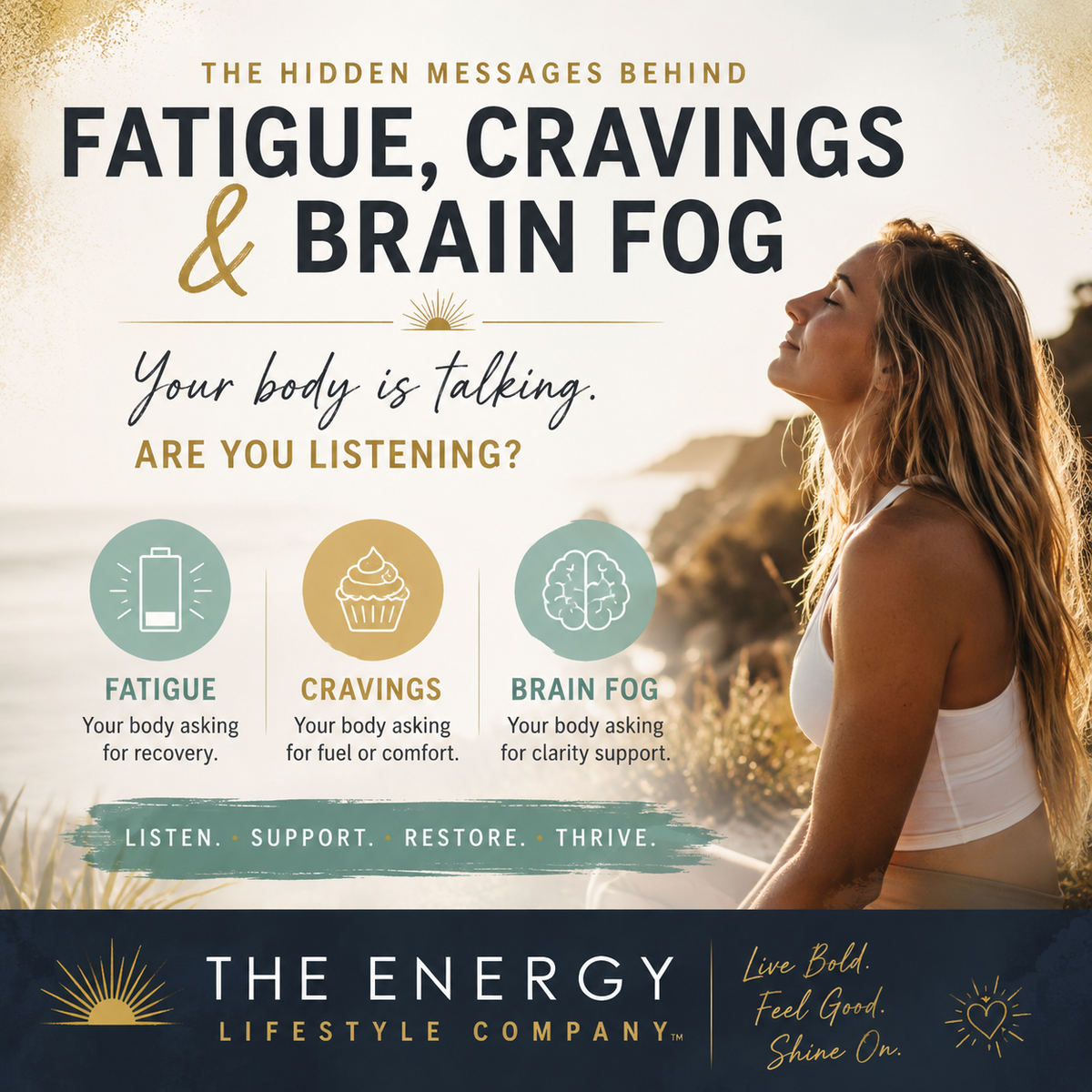
At The Energy Lifestyle Company, we talk a lot about energy — because energy changes everything.
Your mood.
Your motivation.
Your metabolism.
Your focus.
Your confidence.
Your ability to fully experience life.
And yet most people are disconnected from the signals their body is trying to send them.
We’ve normalized exhaustion.
We’ve normalized brain fog.
We’ve normalized stress, cravings, poor sleep, and relying on caffeine instead of real energy.
But here’s the truth:
Your body is not working against you.
It’s communicating with you.
Those symptoms you keep trying to ignore?
They’re feedback.
Your energy is always telling a story.
The question is: are you paying attention?
Fatigue Is Often a Call for Recovery
One of the biggest misconceptions in modern wellness is that more effort creates more energy.
It doesn’t.
More often, it creates depletion.
Fatigue is your body asking for:
- Better sleep
- More sunlight
- Better nourishment
- Nervous system recovery
- Less overstimulation
- More balance
Your body was not designed to stay in constant stress mode.
When your mitochondria — the energy powerhouses of your cells — become depleted from poor sleep, stress, processed foods, emotional overload, or lack of recovery, the body slows you down intentionally.
Not to hurt you.
To protect you.
Sometimes the smartest thing you can do is rest.
Go for a walk.
Get outside.
Hydrate.
Eat real food.
Sleep earlier.
Take a breath.
Energy is built through recovery and rhythm.
Cravings Are Often Information, Not Failure
Most cravings are not about weakness.
They’re signals.
Your body may be asking for:
- More protein
- More minerals
- Better blood sugar stability
- Emotional grounding
- Better hydration
- More stable energy
When people are stressed, undernourished, emotionally overwhelmed, or running on low energy, the body naturally looks for fast fuel and comfort.
That’s biology.
Instead of judging cravings, get curious about them.
At The Energy Lifestyle Company, we teach people to stop fighting their body and start understanding it.
Because the body is usually trying to solve something.
Brain Fog Is a Sign Your Energy Systems Need Support
Brain fog has become incredibly common — but common does not mean normal.
Mental fatigue, forgetfulness, lack of focus, and low motivation are often signs the brain and body are struggling to produce or regulate energy efficiently.
Brain fog can be connected to:
- Poor sleep
- Chronic stress
- Hormonal imbalance
- Thyroid dysfunction
- Dehydration
- Inflammation
- Blood sugar instability
- Lack of movement
- Too much screen exposure
- Low sunlight exposure
Your brain is one of the most energy-demanding organs in your body.
When your energy systems are depleted, mental clarity is often one of the first things affected.
Before reaching for another stimulant, ask yourself:
- Have I hydrated?
- Have I eaten enough protein?
- Have I moved today?
- Have I gone outside?
- Have I slowed down enough to recover?
Sometimes clarity doesn’t come from doing more.
It comes from restoring better.
Your Energy Is Always Communicating
One of the biggest shifts you can make in your health journey is learning to listen to your body instead of overriding it.
The body operates through signals, rhythms, and feedback.
When you begin responding to those signals with supportive habits, energy starts to change naturally.
Sunlight.
Movement.
Adventure.
Protein.
Hydration.
Sleep.
Nature.
Breathwork.
Recovery.
Simple things. Powerful results.
At The Energy Lifestyle Company, we believe energy is one of the most important health markers you can pay attention to because low energy is often the first sign your lifestyle is out of alignment.
This week, slow down long enough to ask:
What is my body trying to tell me?
Live Bold.
Feel Good.
Shine On.
Research & References
- National Institutes of Health — Circadian Rhythm and Metabolic Health
- Harvard Health Publishing — Stress and Energy Regulation
- Cleveland Clinic — Causes of Fatigue and Brain Fog
- Mayo Clinic — Nutrition, Hydration, and Energy Support
- Huberman Lab — Sunlight, Sleep, and Nervous System Research
- Peter Attia, MD — Longevity and Mitochondrial Health